XtreamMOTION: one pipeline, from the model to the screen and back.
XtreamMOTION is the product underneath interactive AI: connect a model through API and we host the live session, deliver every generated frame, play it on any screen, return user input and measure the experience end to end.
Six pieces do the work. Five of them are ours, the model is yours.
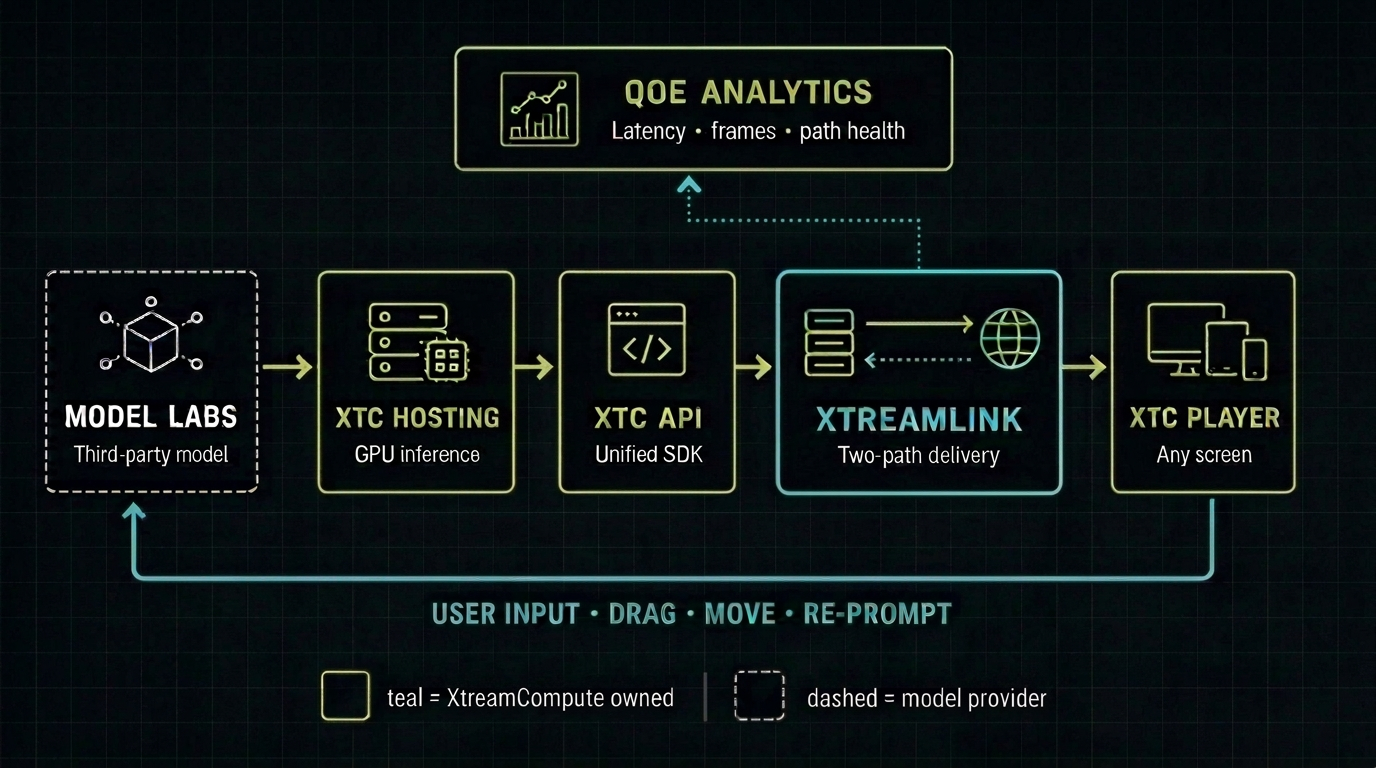
XTC API
One interface, integrated once. Your application starts, controls and ends interactive sessions without being coupled to a particular model, GPU host or delivery method.
Model labs
The AI model is trained by a third party - an in-house lab, a partner, or an open-weight release. This is the one block deliberately outside our stack.
XTC Hosting
The model runs on GPU infrastructure we own, with a serving stack tuned for frame-by-frame, low-latency output rather than batch rendering.
XtreamLINK delivery
The transport layer inside the pipeline. Every frame is scheduled across two independent network paths, with loss concealment so a dropped packet on one path is invisible on the other.
XTC Player
Browser-native playback with no install, plus mobile and TV players, so one interactive session behaves the same way on whatever device it lands on.
XTC QoE Analytics
Per-session visibility into glass-to-glass latency, frame delivery, stalls and path health across every model in production - one view, not one dashboard per vendor.
A session, end to end
Your application calls the XTC API. XtreamMOTION takes it from there: the model generates on our GPUs, frames travel down and input travels back up the same live connection, and every hop is measured while it happens.
Start a session through API
Mint a session token, mount the session in the browser, stream input back.
Hosting, delivery, playback and monitoring sit behind that single call.
Frames flow down, input flows up
Generated frames are delivered live to the XTC Player while drags, camera moves and new prompts stream back to the model. That two-way loop is what makes it interactive rather than a one-way broadcast.
Delivery that survives real networks
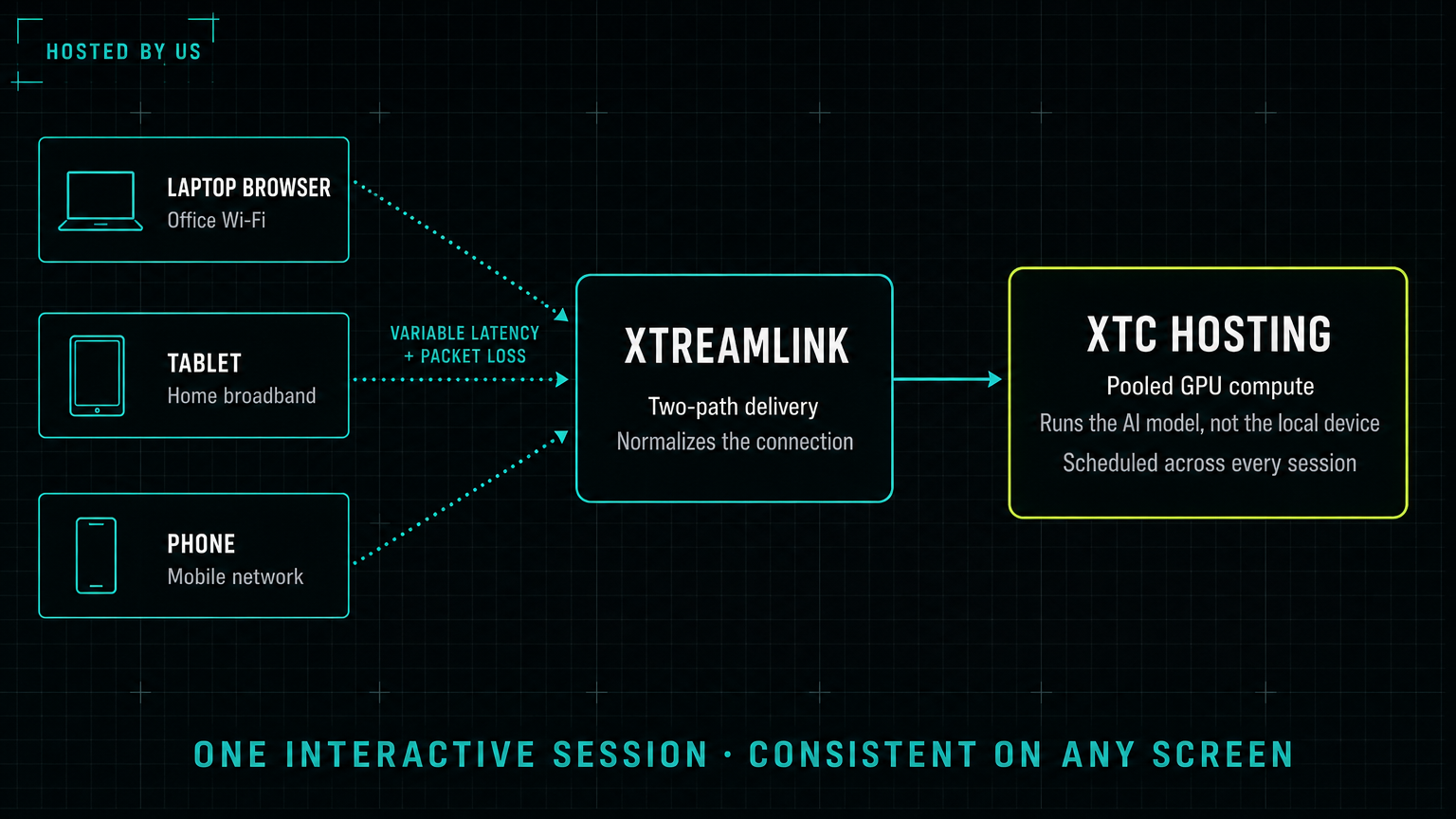
Inside the pipeline, the XtreamLINK delivery layer sends every frame's critical data across two independent paths simultaneously, so routine packet loss on Wi-Fi or mobile never surfaces as a dropped or late frame.
Hosted by us, reached from anywhere
Sessions run on XtreamMOTION GPU infrastructure tuned for live generative output, and the same session reaches a laptop, tablet, phone or TV through the browser - no install on any device.
Built for frame-by-frame, not just video calls
| Capability | XtreamLINK | Tuned WebRTC | Traditional low-latency HLS |
|---|---|---|---|
| Sub-frame-interval scheduling | Yes | Partial | No |
| Simultaneous two-path delivery | Yes | No | No |
| Runs natively in browser (no plugin) | Yes | Yes | Yes |
| Designed for irregular / generative frame timing | Yes | No | No |
| Typical glass-to-glass latency | <50ms | 150-400 ms | 2-30 s |
Comparison rows describe architectural capability of XtreamMOTION's delivery layer, not a specific competitor's measured performance. Full methodology: see Benchmarks.
Optional delivery guarantee for critical workloads
Standard delivery is built for real networks. When a dropped frame is a safety or revenue event - live wagering, telepresence, remote operation - add the reliability tier for a contractual four-nines frame delivery guarantee.