XtreamMOTION for
interactive AI model
on any screen.
Connect a model through XtreamMOTION. We host the live session, deliver every generated frame, and return user input.
Stop waiting for the video.
Start shaping it.
Today’s AI model tools still ask people to submit a prompt and wait for a finished clip. Interactive generation replaces that queue with a continuous session where a drag, camera move or new prompt changes the picture while the idea is still forming.
The model is only the beginning
A fast model can generate the next frame, but a usable product also needs ready GPU capacity, session control, live playback, returning input and end-to-end visibility.
XtreamMOTION closes the loop
XtreamMOTION connects the model, hosting, API, delivery, player and analytics. Your team builds the creative experience instead of assembling the infrastructure around it.
The experience follows the user
The same interactive session reaches a laptop, tablet or phone while the GPU remains remote. The endpoint changes, but XtreamMOTION and the creative loop stay consistent.
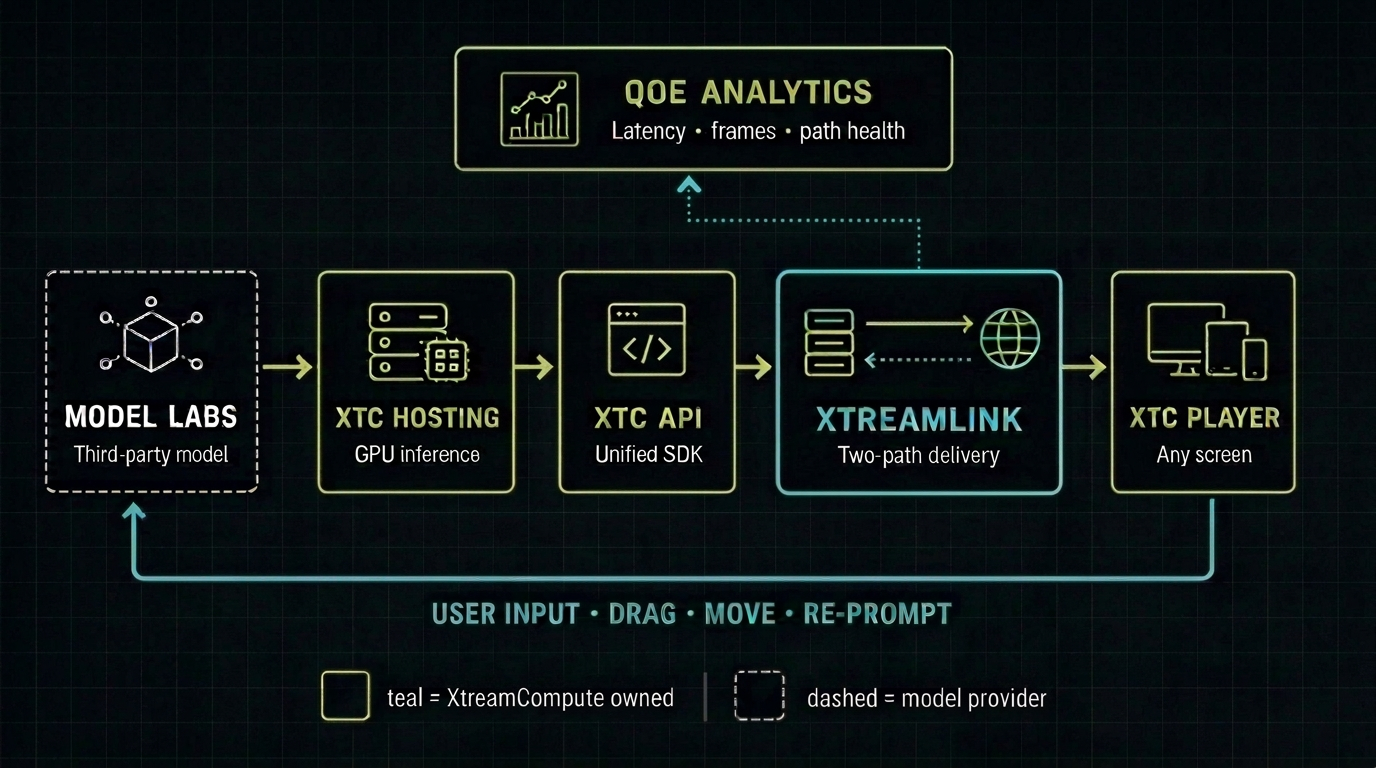
One pipeline, from the model to the screen and back
Six pieces do the work. Five of them are ours, the model is yours.
One interface, integrated once
A single unified API that abstracts away which model is running underneath. Adding or swapping a model does not mean rebuilding the integration.
The model is yours
The AI model is trained by a third party: an in-house lab, a partner, or an open-weight release. This is the one block outside our stack.
Inference tuned for frames
The model is deployed on GPU infrastructure we own, with a serving stack optimised for frame-by-frame, low-latency output rather than batch rendering.
Delivery that stays live
The transport layer at the centre of the pipeline, scheduling every frame so an ordinary single-path stall never surfaces to the user as a dropped or late frame.
The same session on any screen
Browser-native with no install, plus mobile and TV players, so one interactive session behaves the same way on whatever device it lands on.
Session health, while it happens
Per-session visibility into glass-to-glass latency, frame delivery, stalls and path health across every model in production, in one place rather than one dashboard per vendor.
The loop closes at the bottom: whatever the viewer does next - drag, move, re-prompt - streams back upstream through the same connection. That is what makes this an interactive pipeline rather than a one-way broadcast.
Built to survive the real network
The XtreamMOTION pipeline carries every generated frame from the hosted model to the screen, and every input back. Its delivery layer keeps that round trip feeling immediate when an ordinary connection becomes lossy - on Wi-Fi, mobile networks and wired desks alike.
Single pathstalls at the tail
XtreamLINK 2-pathevery frame lands
This simulation shows the delivery layer at work inside the wider pipeline. Reliable transport is one part of XtreamMOTION, alongside hosting, the API, playback and session analytics.
An interactive AI avatar, streamed frame by frame
This is a real XtreamMOTION session. The avatar is generated by the model on our GPUs one frame at a time and delivered to the browser over XtreamLINK, while the viewer steers it.
Centre: the model's output. Each frame is generated in response to the viewer's input and streamed to the screen the moment it exists.
The orange trail is the viewer drawing a motion path on the canvas. That input travels back upstream and the model reacts to it in the frames that follow.
Right: live QoE stats for the session - round-trip time, frame rate, packet loss and delivery timing. In this recording the stream holds 60 fps even at moments when the network is losing packets.
Integrate XtreamMOTION, not a transport
Mint a session token on your server, mount the session in the browser, stream input back. Hosting, delivery, playback and monitoring are handled behind that call.
# install
npm i @xtreamlink/sdk

// mint a short-lived session token on your server
const { session_token } = await fetch("/api/xtream/session", {
  method: "POST",
  body: JSON.stringify({ model: "any-compliant-video-model" }),
}).then((r) => r.json());

// mount the interactive session in the browser
import { XtreamStream } from "@xtreamlink/sdk"

const stream = new XtreamStream({ modelName: "any-compliant-video-model" })
stream.mount("#stage")
await stream.connect(session_token)
The bar an interactive session has to clear
High video quality, stable frame rates, and a response to input that feels immediate rather than “fast for the cloud.”
Where XtreamMOTION earns its keep
If your pixels are generated the instant they are seen, this is the stack underneath them.
Interactive AI model
World models, generative characters, design tools that generate as you drag. Frame-by-frame delivery at conversational latency.
Cloud gaming
Session length and abandonment live in the latency tail, which is exactly the part XtreamMOTION is measured on.
Pixel streaming
Unreal and interactive 3D, playable ads, instant app trials - hosted, delivered and monitored through one integration.
Three slots. Production traffic.
Co-published results.
- Free integration. Our team wires XtreamMOTION into your product.
- Discounted production usage for 12 months. Metered, per concurrent stream-hour.
- Co-published benchmark and case study. Your numbers, our pipeline, public methodology.